The Best Playground Additions for Encouraging Independent Play
Updated on: September 9, 2026
Not every playground activity needs a teacher, lunchtime supervisor or organised group to make it work.
In fact, some of the most valuable playground equipment is equipment that children can approach, understand and use independently.
For schools, this can make a big difference. When children have access to activities they can start themselves, they have more opportunities to make choices, solve problems, practise skills and develop confidence without waiting for an adult to organise a game.
Independent play doesn’t mean children playing alone. It means giving children the freedom to decide what they want to do, how they want to do it and how challenging they want the activity to be.
So, what types of playground equipment are particularly good at encouraging this?
What Is Independent Play?
Independent play is often associated with younger children playing alone, but the principle applies across the primary years.
It might mean a Reception child exploring a play panel by themselves, a Year 2 pupil creating a route between stepping blocks, or a group of Year 5 children inventing their own challenge using playground markings.
The important thing is that the activity doesn’t require an adult to explain, referee or direct every step.
Good equipment for independent play tends to be:
- Easy for children to understand
- Open-ended rather than having one correct way to play
- Suitable for different ability levels
- Available without complicated setup
- Something children can return to repeatedly
- Flexible enough for children to create their own games
That makes independent-play equipment particularly useful during break times and lunchtimes, when children need plenty of opportunities to make their own choices.
1. Play Panels: Instant Activities Without Complicated Rules
Play panels are a great way to introduce independent activities into the playground.
Unlike a structured game that requires several players or someone to explain the rules, many play panels can simply be approached and explored.
Children can investigate, interact and experiment at their own pace.
For younger children especially, this can provide an opportunity to develop curiosity and confidence without needing an adult to direct the activity.
Play panels can also encourage children to play alongside one another. One child might start using a panel, another joins in and before long they’ve created their own game.
This makes them particularly useful for mixed-age playgrounds, where children can interact with equipment according to their own level of development.
Best for: EYFS and KS1, sensory exploration, curiosity, interactive play and quieter independent activities.


2. Freestanding Equipment: Let Children Create the Challenge
Freestanding equipment offers something that permanently fixed playground equipment can’t always provide: flexibility.
With equipment such as stepping blocks and beams and train and carriage sets children don’t necessarily need to be given an activity.
They can decide what to do themselves.
A child might simply walk across a beam.
Another might create a route between several stepping blocks.
A group might turn the equipment into an obstacle course.
Because the equipment is moveable, schools can also change the layout to create new challenges or zones.
This open-ended approach is particularly valuable because there isn’t necessarily a single “correct” way to use the equipment. Children can decide how difficult they want to make their activity.
Best for: Developing confidence, balance, coordination, creativity and problem-solving through self-directed physical play.


3. Playground Game Markings: Activities Children Can Start Themselves
Permanent playground markings are another excellent way to encourage independent play.
The major advantage is that the activity is already there.
There’s no equipment to find, no pieces to lose and no adult required to set it up.
A child can simply see a familiar game marking and decide to play.
Depending on the design, playground markings can encourage everything from physical activity and coordination to communication and problem-solving.

Popular examples include:
Many can be used individually, while others naturally encourage children to invite friends to join them.
This makes playground markings particularly good for self-directed play, because children can choose activities according to their mood and interests.


The Difference Between Independent Play and Free Play
It’s worth making an important distinction.
Independent play doesn’t necessarily mean playing alone.
A child might independently decide to start a game of Snakes & Ladders and then invite three friends to join.
A group of children might create their own obstacle course using stepping blocks.
Two children might use Mirror Me without an adult telling them how to play.
The independence comes from the children initiating and directing the activity themselves.
That’s why open-ended equipment can be so valuable in a school playground.
Why Independent Play Matters in a School Playground
Giving children more opportunities to direct their own play can support skills that aren’t always developed through adult-led activities.
Children have opportunities to: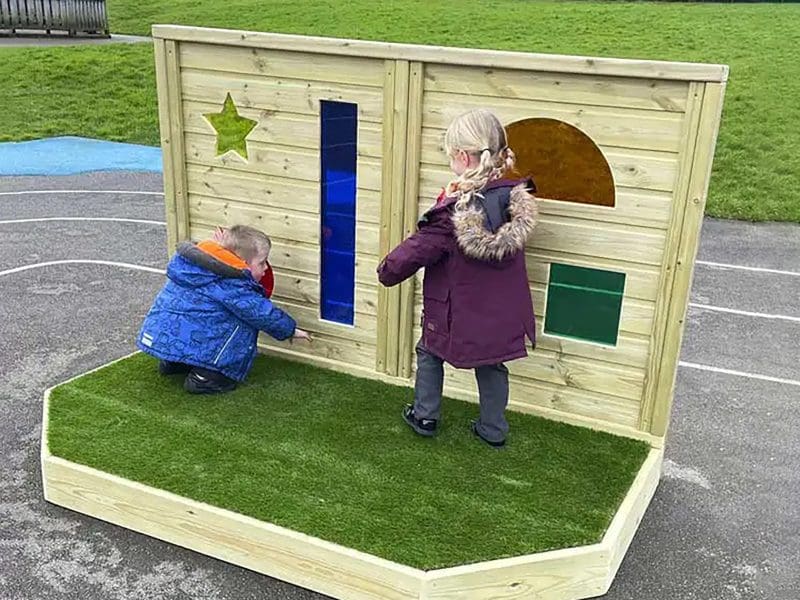
Make decisions
They choose what they want to play and how they want to use the equipment.
Solve problems
They work out how to complete a route, overcome a challenge or adapt a game.
Develop confidence
Successfully completing something they’ve chosen to attempt can be particularly rewarding.
Communicate with others
Independent activities can naturally develop into shared games where children negotiate rules and take turns.
Use their imagination
Open-ended equipment doesn’t dictate exactly what the activity has to be.
Independent Play Can Help Make Break Times Easier
For schools, there’s another important benefit.
When children have access to a variety of activities that they can initiate themselves, the playground doesn’t rely entirely on adults to provide entertainment.
This is particularly valuable during busy break and lunchtime periods.
Instead of having to organise every activity, staff can provide a well-designed environment where children have clear, accessible choices.
This doesn’t mean supervision becomes unnecessary. It means adults can focus on supervising and supporting children rather than having to constantly generate activities for them.
For more ideas on creating a playground that supports positive behaviour, see our guide: How to Improve Playground Behaviour Without More Staff.
Create Choices, Not Just Equipment
The best independent-play playgrounds aren’t necessarily filled with equipment.
They’re designed around choice.
One child might want to be physically active.
Another might want to experiment with music.
Another might prefer a game.
Another might want to challenge themselves on a balance route.
And another might want to play alongside friends without joining a structured team game.
Combining different types of equipment and markings gives children the freedom to decide how they want to spend their break time.
The Best Playground Equipment for Independent Play
| Equipment | How it encourages independent play |
|---|---|
| Play Panels | Open-ended interactive activities that children can explore at their own pace |
| Freestanding Equipment | Allows children to create their own routes, challenges and games |
| Stepping Blocks & Beams | Provides different levels of balance and movement challenge |
| Musical Equipment | Encourages children to experiment, create and express themselves |
| Playground Games & Markings | Provides ready-to-use activities that children can start without setup |
The key is variety.
By offering different types of play, schools can give children more control over how they spend their time outdoors.
Give Children More Ownership of Their Playground
A successful playground doesn’t need an adult to tell children what to do every minute.
It should give them the environment, equipment and opportunities to make their own decisions.
From a child exploring a play panel to a group creating an obstacle course with stepping blocks, independent play can take many forms.
The best equipment gives children enough structure to get started, but enough freedom to decide where the activity goes next.
At Fun & Active Playgrounds, our range of play panels, freestanding equipment, stepping blocks and beams, musical equipment and playground markings can help schools create outdoor spaces that encourage children to play, explore and challenge themselves independently.
Looking to make your playground more engaging without relying on organised activities?
Get in touch to discuss how we can help you create a space with more opportunities for independent play.