10 of the Most Popular Playground Markings for Schools in 2026
Updated on: August 12, 2026
When schools invest in new playground markings, they’re looking for more than something colourful to brighten up the tarmac.
The best playground markings encourage children to move, play and interact while also making better use of the space schools already have. Some support PE and physical development, others bring learning outside, while traditional games can help children socialise and stay active at break times.
With hundreds of playground marking designs available, choosing the right ones can feel overwhelming.
So, what are schools choosing?
We’ve picked 10 of the most popular playground marking types for schools in 2026, covering everything from active trails and sports courts to traditional playground games and educational designs.
1. Active Spot Circuit Markings
If your priority is getting children moving, an Active Spot Circuit is an excellent place to start.
Active Spot markings provide a series of simple physical activities that children can use individually or as part of a circuit. They’re particularly useful because they don’t require a teacher, PE equipment or a complicated setup.
Children can use them for:
- Warm-ups
- Brain breaks
- Active playtimes
- PE activities
- Fitness challenges
- Movement breaks


They can also be combined with other activity stations to create a completely bespoke circuit.
For schools looking for a permanent way to encourage movement throughout the day, Active Spot markings make a lot of sense.
2. Hopscotch Playground Markings
Some playground games never go out of fashion.
Hopscotch remains a playground favourite because it’s simple to understand, requires no additional equipment and can be enjoyed by children of different ages and abilities.
Modern thermoplastic hopscotch designs also go far beyond the traditional version. Schools can choose from different layouts and themes, including traditional, rocket, alien, rainbow, sunflower and times table designs.
Hopscotch can support:
- Balance and coordination
- Number recognition
- Counting
- Physical activity
- Turn-taking
- Social interaction


There are also larger 3-way and 4-way designs, allowing several children to play simultaneously.
For a relatively small investment, it’s one of the simplest ways to add an active game to an otherwise empty playground.
3. Trail Playground Markings
Trail markings are an excellent way to turn a playground perimeter or unused section of tarmac into an active route.
Children can move through a sequence of different challenges, including activities such as jumping, hopping, sprinting and balancing.
They’re particularly useful for schools because the trail can often be positioned around the edge of a playground, leaving the central space available for other activities.
There are several ready-made options available, including:
- Active Trail
- Adventure Trail
- Fun & Active Trail
- Nature Trail
- Themed trails such as Safari, Space and Under the Sea

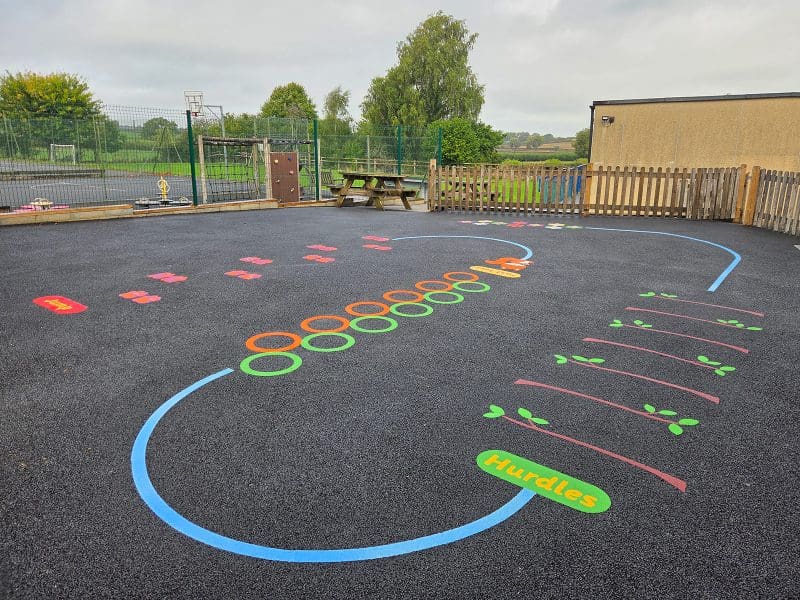
Trail designs can also be adapted to suit the available playground space.
And if a ready-made design isn’t quite right, schools can build their own trail by selecting individual stations.
4. Sports Court Markings
For schools wanting to maximise their outdoor PE provision, permanent sports court markings are a popular choice.
Instead of relying on temporary cones, goals or other equipment that needs to be set up and put away, permanent markings create a ready-to-use space.
Depending on your playground, this could include:


Multi-court markings can be particularly useful where space is limited, allowing one area to support several different sports.
Sports markings can also be used beyond PE lessons, providing opportunities for active break times, lunchtime clubs and after-school activities.
5. Roadway Playground Markings
Roadway markings turn the playground into an interactive environment where children can explore road safety through play.
A roadway can incorporate features such as roads, junctions, crossings, roundabouts and other familiar features of the built environment.
For younger children especially, this creates opportunities to practise concepts such as:
- Crossing safely
- Recognising road layouts
- Understanding traffic
- Following directions
- Using pedestrian crossings


The big advantage is that road safety becomes something children can actively practise rather than simply learn about in a classroom.
6. Target Playground Markings
Targets are incredibly versatile.
At first glance, a target might seem like a simple game, but it can be used in countless ways. Children can throw balls or beanbags at different sections, create scoring challenges or use the targets as part of wider PE activities.
Target markings can help develop:
- Hand-eye coordination
- Throwing accuracy
- Concentration
- Numeracy
- Teamwork
- Physical confidence


They’re also easy for teachers to incorporate into structured activities, while children can create their own games during free play.
Targets are already a recognised playground marking option for developing throwing, catching and aiming skills.
7. Snakes & Ladders
Sometimes the best playground markings are the ones children already know.
Snakes & Ladders brings a familiar board game outdoors and gives children a reason to interact with one another during break time.
A playground-sized version can encourage:
- Turn-taking
- Communication
- Counting
- Cooperation
- Social interaction
- Resilience
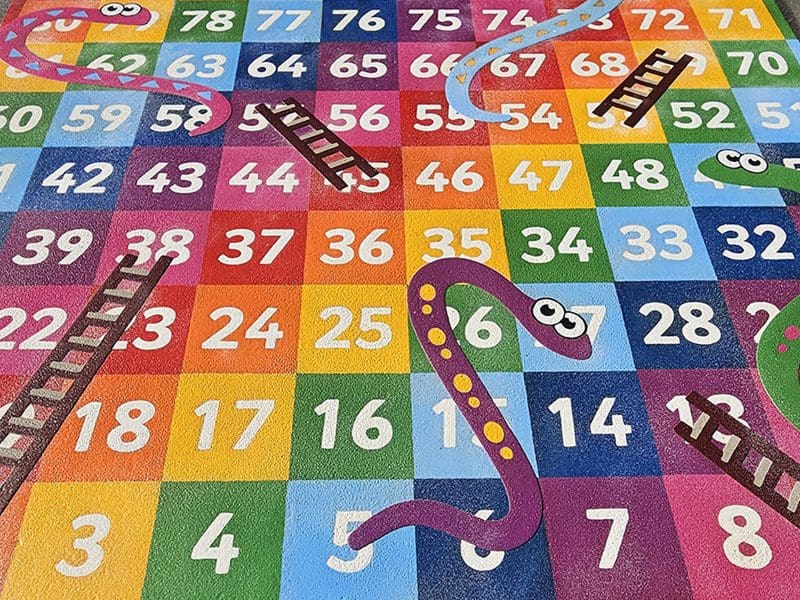

It also provides a useful alternative to purely physical activities, giving children a reason to gather and play together.
That makes it particularly valuable in a playground designed around different types of play rather than simply encouraging children to run around.
8. Mirror Me & Dance With Me
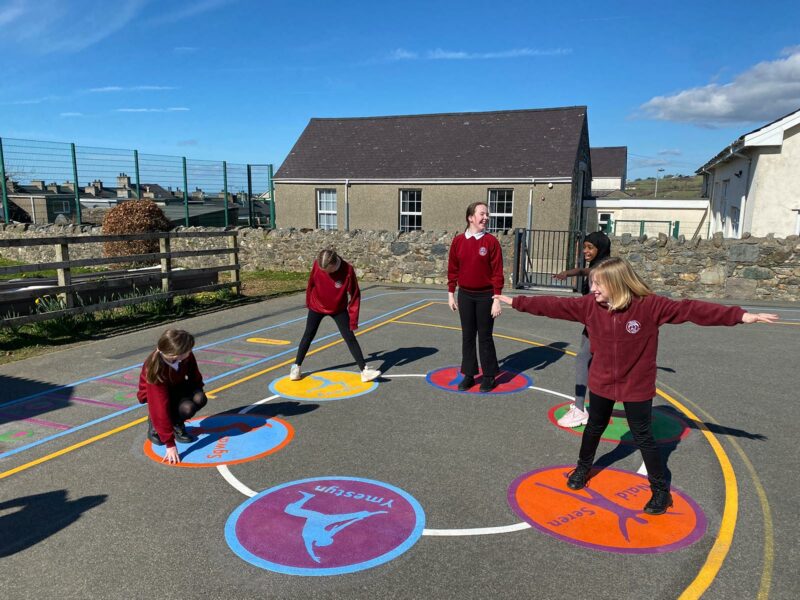
Not every playground game needs to be competitive. Mirror Me and Dance With Me are designed to get children moving together, encouraging communication, cooperation and creativity through simple, interactive activities.
With Mirror Me, one child leads while another copies their movements, making it a great way to develop observation, concentration and coordination. Dance With Me takes a more creative approach, encouraging children to follow, create and share dance movements with others.
Both games can be adapted to suit different ages and abilities, from simple movements for younger children to more imaginative sequences and challenges for older pupils. They’re also versatile enough to be used during break times, PE lessons, warm-ups or movement breaks.


Fun & Active offers standard and deluxe versions of both Mirror Me and Dance With Me, with each available in 3-station or 5-station formats. This gives schools plenty of flexibility to choose the option that best suits their available space and how many children they want to accommodate.
Whether children are copying a friend’s movements or creating their own dance routines, these markings provide an easy and engaging way to bring more movement, interaction and fun to the playground.
9. Maths Playground Markings
Why keep maths inside the classroom?
Maths playground markings give children an opportunity to practise numbers, calculations and problem-solving while they’re moving.
Possibilities include:
- Number grids
- Ten squares
- Clocks
- Maths targets
- Number characters


Combining movement with learning can make abstract concepts more engaging, particularly for children who respond well to practical activities.
And because the markings are permanently installed, teachers can use them whenever they need an outdoor learning activity without having to prepare a separate resource.
10. Phonics and Literacy Playground Markings
Outdoor learning isn’t just about maths and physical education.
Phonics and letters markings can transform an otherwise unused area of playground into an additional learning resource.
Schools can use outdoor markings to support:
- Letter recognition
- Phonics
- Spelling
- Vowel recognition
- Vocabulary
- Reading activities


The physical element also means children can combine movement with learning. For example, hopping between sounds or running to the correct letter.
For EYFS and KS1 settings in particular, this can be an effective way to make learning more active and engaging.
Which Playground Markings Are Right for Your School?
There’s no single playground marking that’s right for every school.
The best choice depends on what you’re trying to achieve and how your existing space is used.
If you want to encourage more physical activity
Consider:
Active Spot Circuits, Trail Markings and Sports Courts
If you’re looking for outdoor learning opportunities
Consider:
Maths, Letters and Phonics markings
If you want to improve social play
Consider: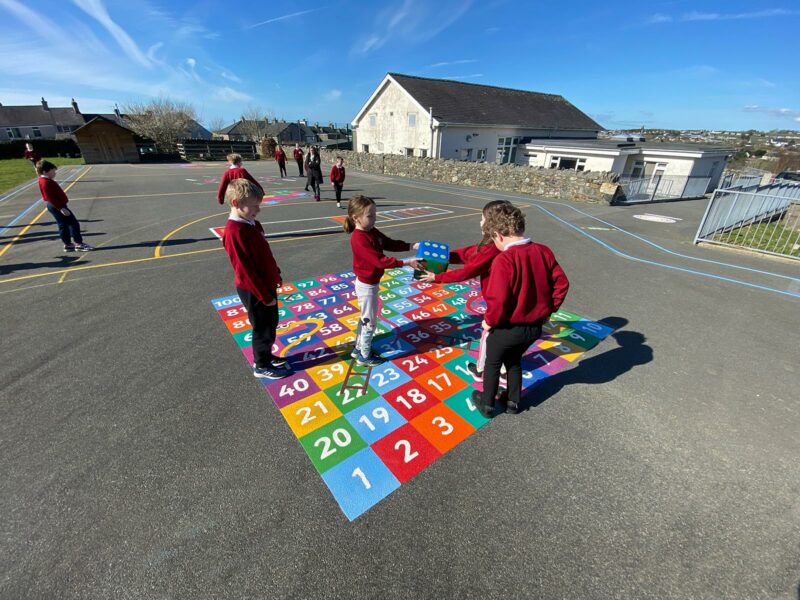
Hopscotch, Snakes & Ladders and Mirror Me / Dance With Me
If you have awkward, unused perimeter space
Consider:
A Build Your Own Trail
And if you have a specific space or set of objectives in mind, there’s no reason to limit yourself to one category.
Many of the most effective playground designs combine several different types of marking to create distinct areas for learning, movement, sport and social play.
Can Playground Markings Be Customised?
Yes.

One of the biggest advantages of thermoplastic playground markings is the flexibility they offer when designing a playground.
Schools don’t necessarily need to choose a standard design and install it exactly as shown. Designs can be adapted to suit the size, shape and layout of your playground, and bespoke markings can be created where a particular school has something specific in mind.
Trail markings are another good example. Alongside ready-made trails, schools can create a Build Your Own Trail using individual movement stations, allowing the finished route to be designed around the space available.
This means a playground doesn’t have to look like everyone else’s.
How Long Do Playground Markings Last?
The longevity of a playground marking depends on factors including the surface, location, usage and maintenance.
Fun & Active’s thermoplastic playground markings come with a four-year warranty and can often last upwards of ten years. The material is designed to withstand the demands of daily school use while retaining its colour and performance.
That makes playground markings a potentially cost-effective way of transforming an outdoor space without taking on the maintenance requirements associated with some other playground improvements.
Create a Playground Children Want to Use
The most successful playgrounds aren’t necessarily the ones with the most equipment.
They’re the ones that give children reasons to play.
A hopscotch encourages children to jump. A target gives them something to aim for. A trail creates a journey. A sports court creates a space for games. A maths marking turns learning into movement.
By combining different types of playground marking, schools can create an outdoor environment that supports physical activity, learning, imagination and social interaction throughout the school day.
At Fun & Active Playgrounds, we have hundreds of thermoplastic playground marking designs to choose from, alongside bespoke design options for schools that need something tailored to their space.
Not sure which markings would work best for your playground? Get in touch with our team for a free site survey and playground plan.